How Does Obedience Show Up in Action? The Two Sons and a Call to Obey Matthew 21:28-32
Published 1 November 2026
Words can sound faithful while a life still stands still. A promise can be quick, polite, and impressive, yet never become action. Jesus told a short parable about two sons to expose that gap between what people say and what they do.
The story is simple. A father gives the same command to both sons. One refuses, then changes his mind and goes. The other agrees, then does nothing. Jesus asks a question that removes all hiding places: which one did the will of his father?
The answer is clear. Obedience is shown in action, not words.

What does Matthew 21:28-32 say?
Here is the passage from Matthew’s Gospel:
Matthew 21:28-32, KJV But what think ye? A certain man had two sons; and he came to the first, and said, Son, go work to day in my vineyard. He answered and said, I will not: but afterward he repented, and went. And he came to the second, and said likewise. And he answered and said, I go, sir: and went not. Whether of them twain did the will of his father? They say unto him, The first. Jesus saith unto them, Verily I say unto you, That the publicans and the harlots go into the kingdom of God before you. For John came unto you in the way of righteousness, and ye believed him not: but the publicans and the harlots believed him: and ye, when ye had seen it, repented not afterward, that ye might believe him.
Jesus does not make the point hard to understand. He lets the religious leaders answer for themselves. The first son did not begin well, but he changed. The second son spoke well, but he never moved.
The question is not which son sounded more respectful. The question is which son actually did the father’s will.
That question still reaches into daily life. It reaches into worship, prayer, repentance, service, forgiveness, generosity, and faith. It asks whether belief has become movement. It asks whether the mouth and the life are walking in the same direction.
Why did Jesus tell the parable of the two sons?
Matthew 21 places this parable in a tense moment. Jesus is speaking to the chief priests and elders. These leaders had seen John the Baptist call people to repentance. They had seen sinners respond. They had seen lives change. Yet many of them refused to believe.
The parable exposes a painful truth. Some people who appeared far from God were turning towards Him. Some people who sounded religious were resisting Him.
Jesus mentions “publicans and harlots”, people widely despised in that society. Tax collectors were often seen as traitors and cheats. Prostitutes carried public shame. Yet many of these people believed John’s message and repented. They did not merely admire the idea of change. They acted on it.
The religious leaders had the Scriptures, the titles, the language, and the public reputation. Yet when God’s call came through John, they did not respond with humble faith.
That is why this parable is so searching. It refuses to let outward appearance become a substitute for a surrendered heart.
Which son obeyed the father?
The first son said, “I will not.” His first response was wrong. There is no need to soften it. He resisted his father’s will. He spoke out of rebellion or reluctance.
But the story does not end there.
Jesus says, “but afterward he repented, and went.” That phrase matters. He changed his mind. Then he changed his direction. Repentance did not remain a private feeling. It produced visible action.
The second son said, “I go, sir.” His words were respectful. He sounded willing. He gave the right answer. If someone had only heard the conversation, they may have thought he was the faithful son.
But Jesus adds, “and went not.”
The difference between the two sons is not personality. It is not style. It is not who sounded better in the moment. The difference is response.
The first son’s life moved into line with the father’s command. The second son’s words never became work.
This is where the parable presses close. It is possible to say the right things about God and still refuse Him. It is possible to agree with truth and still avoid doing what truth requires. It is possible to sing, pray, listen, and nod, while delaying the very step God has placed before us.
What does this parable teach about obedience?
The parable teaches that obedience is more than agreement. It is more than intention. It is more than emotion. It is the act of doing what the Father commands.
That does not mean words do not matter. Words can be sincere. Confession matters. Prayer matters. Worship matters. A spoken yes to God can be beautiful when it comes from a faithful heart.
But words lose their weight when they are used to avoid action.
A person may say:
“I forgive,” but keep feeding bitterness.
“I trust God,” but refuse to release control.
“I love my neighbour,” but ignore someone in need.
“I believe the gospel,” but never turn from known sin.
“I will serve,” but always wait for a more convenient time.
The second son’s danger is familiar because it is so easy to hide in polite faith. He does not argue. He does not openly rebel. He simply does not go.
That kind of disobedience can look calm from the outside. It can sound respectable. It can even blend into religious life. But the father’s vineyard remains untouched.
Jesus is calling for a faith that moves.
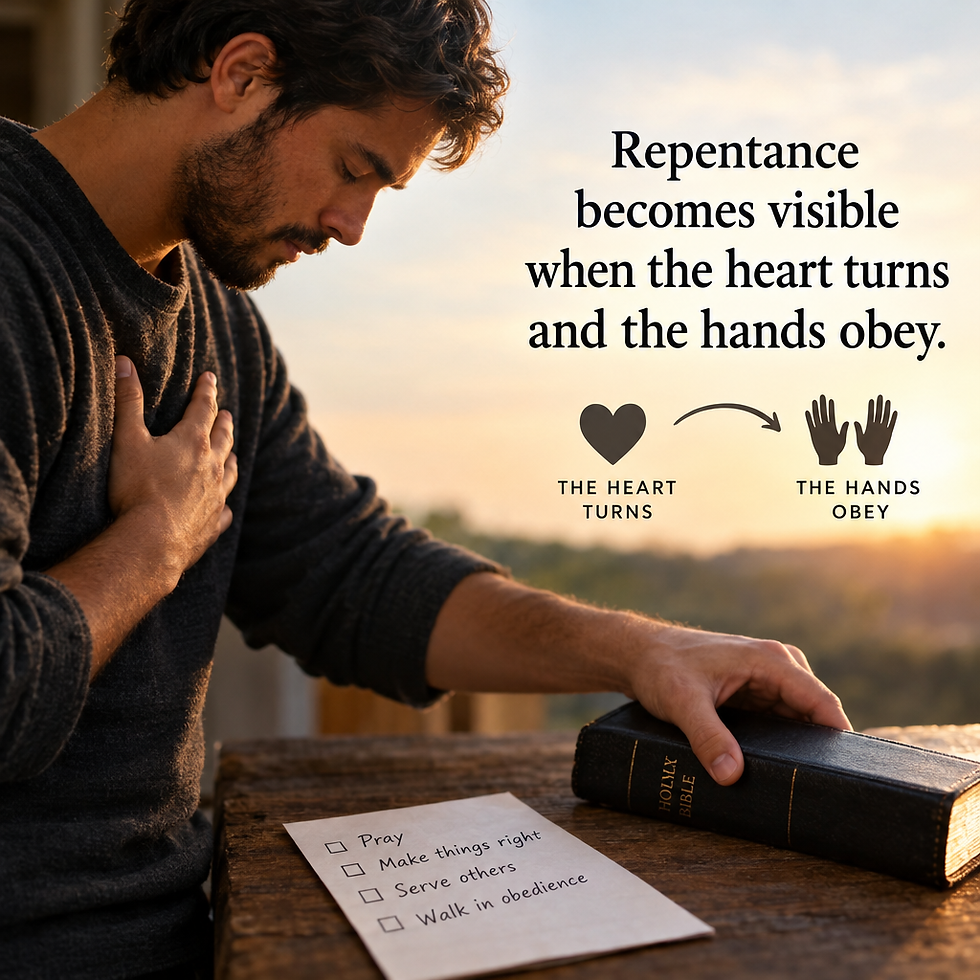
Why is repentance more than feeling sorry?
The first son “repented, and went.” Both parts belong together.
Repentance in Scripture is not just regret. It is not only feeling bad about a wrong decision. It is a change of mind that leads to a change of direction. The first son did not merely wish he had answered better. He went to the vineyard.
This is hopeful. The first son began badly, but he did not have to remain there. His first response was not his final response.
That matters for anyone who has delayed, resisted, ignored, or failed. The parable does not say, “The son who gave the best first answer pleased the father.” It says the son who eventually did the father’s will was the one who obeyed.
Grace gives room to turn. But grace does not call people to stay where they are. It calls them home, and then it sends them into the vineyard.
Repentance may look like making the apology. It may look like ending a hidden compromise. It may look like returning to prayer after a dry season. It may look like showing up to serve after months of excuses. It may look like receiving Christ not only as a comfort, but as Lord.
The proof is not a dramatic speech. The proof is the next faithful step.
How can words become a cover for disobedience?
The second son shows how easy it is to confuse agreement with surrender.
He says the right thing. He calls his father “sir.” He gives a respectful answer. Nothing about his speech sounds rebellious. Yet his life tells a different story.
This can happen in religious life when language becomes a hiding place. People may know how to speak about faith without yielding to God. They may know the songs, the prayers, the verses, and the expected answers. But the Father is not seeking performance. He calls His children to do His will.
Jesus was speaking to leaders who had spiritual knowledge. They were not ignorant of religious language. They were experts in it. Yet they missed the call to believe and repent when John came “in the way of righteousness”.
That warning should create humility, not pride. It is easy to look at the second son and judge him. It is harder to ask where his pattern appears in our own lives.
Where have we said yes to God but not gone?
Where have we agreed in principle but resisted in practice?
Where have we used delay as a quieter form of no?
These questions are not meant to crush. They are meant to awaken. The Father’s command is not vague. There is a vineyard. There is work to do. There is a real call to answer.
What does the vineyard represent for us today?
In the parable, the father says, “Son, go work to day in my vineyard.” The setting points to responsibility. The son belongs to the family, and the father calls him into the work.
For us, the vineyard may be any place where God’s will needs to be obeyed. It may not look dramatic. It may be close, ordinary, and easy to overlook.
The vineyard may be:
A relationship that needs truth and forgiveness.
A habit that needs repentance and discipline.
A neighbour who needs practical love.
A church family that needs faithful service.
A workplace where integrity matters.
A private decision nobody else sees.
A call to believe the gospel and stop postponing surrender.
The father says, “to day.” That word carries urgency. Not someday. Not when life becomes easier. Not when every feeling lines up. Today.
Delayed obedience often feels safer because it keeps the appearance of willingness. But delay can become disobedience when God has made the next step clear.
The vineyard is not entered by good intentions. It is entered by going.
How does this parable point us to the gospel?
The parable confronts hypocrisy, but it also opens a door of mercy. Jesus tells the religious leaders that tax collectors and prostitutes were entering the kingdom before them because they believed and repented.
That does not mean sin does not matter. It means God welcomes those who turn to Him in faith. The kingdom is not entered by looking respectable. It is entered by responding to God’s call.
This is good news for the openly broken and the quietly religious. Christ receives sinners who repent. He calls proud hearts to humility. He exposes false promises so that real faith can begin.
The gospel does not invite people to impress God with words. It calls them to trust Christ, turn from sin, and walk in new life. The Son of God did not merely speak of love. He acted. He came. He served. He suffered. He died. He rose again.
Jesus is the perfectly obedient Son. Where both sons in the parable reveal human failure in different ways, Christ reveals complete faithfulness. He did the Father’s will fully.
Those who follow Him are called to a living faith, one that bears fruit.
What should we do with this passage today?
The right response to Matthew 21:28-32 is not to admire the parable and move on. Jesus gives it to bring a decision into the open.
Take a quiet moment and ask:
What has God already made clear to me?
Where have I said yes with my mouth but no with my actions?
What step of repentance have I delayed?
Who needs my apology, help, honesty, or forgiveness?
What would it look like to go into the vineyard today?
Do not wait for a more impressive moment. Do not hide behind vague intentions. Do not measure faithfulness by how sincere yesterday’s words sounded.
Act on the light God has given you.
If you need to repent, repent. If you need to believe, believe. If you need to serve, serve. If you need to forgive, forgive. If you need to stop resisting Christ, surrender to Him now.
The call to action is simple: choose one clear act of obedience today, pray for God’s help, and do it before the day ends.
The parable of the two sons leaves us with a question we cannot avoid. Which son did the will of his father?
The answer is still the same.
The one who went.

Comments